
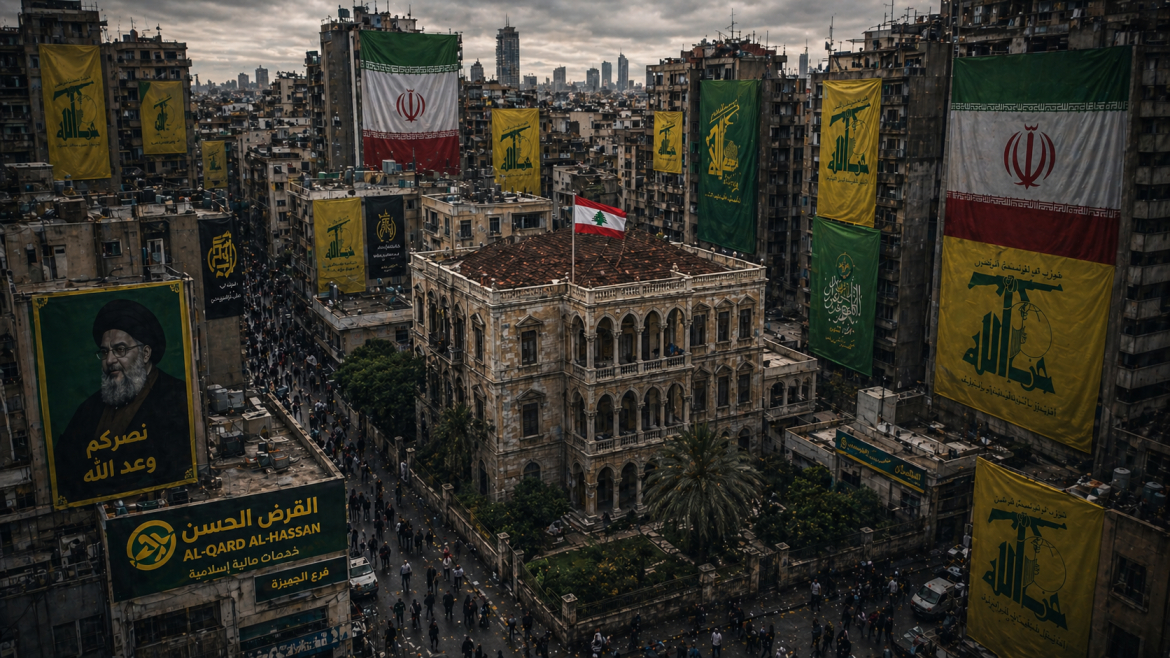
For more than forty years, the Islamic Republic of Iran has pursued a singular, calculated ambition: The transformation of Lebanon into a total satellite state through its primary proxy, Hezbollah. This was never a journey toward partnership, but a systematic campaign to hollow out the Lebanese Republic, piece by piece. By infiltrating the military, social, financial, and judicial nervous systems of the country, Tehran sought to ensure that the Lebanese state remained too weak to govern itself, yet just strong enough to serve as a shield for a foreign agenda.
However, this multi-generational project of attrition ultimately hit a definitive wall; despite forty years of institutional capture and strategic weakening, the attempt to fully replace the Lebanese state with an Iranian surrogate failed to achieve its final, total objective. What follows is the breakdown of this long-term strategy and the milestones of its attempt to capture a nation, beginning with the foundational fires of 1983.
The Foundation & “Emancipation” (1983–1989)
- October 1983: The “Coming Out” Party. Following the 1982 Israeli invasion, Iran’s Revolutionary Guard (IRGC) established a foothold in the Bekaa Valley. The devastating bombings of the US Marine barracks and French Paratroopers in Beirut signaled the arrival of a new, Iranian-backed force that would eventually coalesce into Hezbollah. The party of God was behind many terrorist operations and kidnappings in Beirut in the 90’s.
- February 1985: The Hezbollah Manifesto. The group emancipated itself from the shadows, publishing its first open letter. It declared total allegiance to Iran’s Supreme Leader (Wilayat al-Faqih) and called for the establishment of an Islamic state in Lebanon, framing itself as the vanguard against Western and Israeli influence. During that period, the party shifted from conducting military operations against Israel into solidifying the internal shiite fanbase, while conducting heavy clashes with Nabih Berri’s Amal Movement, and other fightings with Druze PSP, Palestinians in refugee camps and other smaller Shia factions.
- 1985–1989: The “War of the Camps.” Amidst the chaos of the Civil War, Hezbollah focused on consolidating power within the Shia community, often clashing with the more secular/nationalist Amal Movement, eventually asserting dominance as Iran’s primary proxy. Hezbollah imposed very harsh violent reprisals to impose a certain doctrine, fear and control over the Shia population.
Institutional Infiltration & The Syrian “Tandem” (1990–2000)
- 1992: Entry into Parliament. Under Iranian direction, Hezbollah transitioned from a purely underground militia to a political party. This began the infiltration phase, where the group sought to protect its weapons by becoming an indispensable part of the Lebanese state. Nevertheless, they entered the Lebanese parliament but never took part in any government until 2005; keeping a military propaganda of their operations against the south Lebanon army (SLA).
- The Hafez al-Assad Era (1990s): During this decade, Iran operated under the “Syrian Umbrella.” Hafez al-Assad acted as a cold, calculating gatekeeper, balancing Hezbollah’s resistance activities with his own regional interests. Iran provided the funding and ideology; Syria provided the logistical corridor. But Al-Assad senior always limited Iran’s ambitions and control in Lebanon, he was involved in their every move, statement or military reinforcement or training of Hezbollah’s operatives. The Iranians didn’t like that.
- May 2000: The “Divine Victory.” Following the Israeli withdrawal from South Lebanon, Iran’s plan shifted. No longer just a resistance group, Hezbollah was branded as the protector of Lebanon, a narrative used to justify maintaining its massive arsenal outside state control. The expected death of Hafez Al-Assad a month later gave the Iranians the complete liberty to grab the Lebanese dossier, and impose a new rule as part of their regional Islamic plan.
The Bashar Era & Financial Machinations (2000–2005)
- July 2000: The “Bashar Miracle.” The transition of power from Hafez to Bashar al-Assad removed the old guard gatekeepers. Bashar, more ideologically aligned and personally closer to Hezbollah’s leadership, allowed Iran much deeper and more direct access to Lebanese institutions. Al-Assad junior was weak in dealing with the Iranians, he lost his father’s position in favor of close aids who opened bigger channels with the Iranians, and beginning 2001 Iran had already set its two feet in Lebanon.
- 2003: The Al-Madina Bank Scandal. This was a pivotal moment in Hezbollah’s financial history. The bank was used as a massive money-laundering machine for Iraqi money, Syrian intelligence, and Hezbollah funds. It revealed how the group had successfully infiltrated the Lebanese banking sector to bypass international sanctions. The scandal was quickly controlled under Syrian presence, many fled, some eliminated and the bank was closed afterwards.
- February 2005: The Assassination of Rafic Hariri. The elimination of Lebanon’s most powerful Sunni leader (and critic of Syrian/Iranian dominance) cleared the path for total hegemony. The scene was open since 2001, and for the Iranians to make a big political entry they had to create a massive blow, thus, decapitating the head of a political leadership, and what’s better than being a Muslim Sunni such as Hariri. Syria’s Bachar was playing an execution role, part of the larger operation that was planned by Iran and Hezbollah special group led by Imad Mughniyeh. While the UN-backed STL later indicted Hezbollah members, the event effectively decapitated the Lebanese political movement.
Conflict & Domestic Dominance (2006–2010)
- July 2006: The July War. Triggered by a Hezbollah cross-border raid, the war decimated Lebanese infrastructure but paradoxically strengthened the Iranian Plan. The war was unprovoked in a south Lebanon that was regained totally in 2000 by Israel; but Iran needed another massive blow to go deeper into Lebanese institutions and have the major decision making in Lebanon. In few months, Iran funded the reconstruction directly through its own NGOs, bypassing the Lebanese government and creating a state-within-a-state social service network.
- May 2007: The Battle of Nahr al-Bared. While primarily a fight between the Lebanese Army and Fatah al-Islam, Hezbollah famously declared a “Red Line” over the camp, testing the Army’s resolve and ensuring that no state force could fully operate in sovereign militant pockets. Hezbollah and Iran rejected any credits to the Lebanese Army, and refusing its growth into a strong army while vetoing any military aids from the USA or France. Later on, Hezbollah operatives assassinated Francois Hajj, key figure during the battle and whose mentality and military merit would have led him to become the General Staff of the Lebanese Army. Such appointment was against Hezbollah and Iran’s directives.
- May 7, 2008: The Armed Uprising. When the Lebanese government tried to shut down Hezbollah’s private telecommunications network and fire the airport security chief (aligned with the group), Hezbollah’s fighters seized West Beirut. This “Day of Glory” (as Nasrallah called it) proved that Hezbollah’s weapons were now directed inward to dictate Lebanese domestic policy. This move was stopped when Hezbollah’s fighters tried to launch an attack on the Chouf, fief of the Druze and Walid Joumblatt, they were stopped violently with many casualties, which refrained them to continue. This drastic period ended with the Doha Summit that led to the election of Michel Sleiman as president of Lebanon, who was considered a soft-liner by Iran, only until the last year of his presidency.
The Regional Hegemon & The Syrian Pivot (2011–2019)
- 2012–2013: The Syrian Intervention. Iran ordered Hezbollah into the Syrian Civil War to save the Assad regime. This transformed Hezbollah from a local Lebanese player into a regional expeditionary force, training “fatimiyoun” and “zinabiyoun” brigades and creating a land bridge from Tehran to Beirut. The entire Radwan force was exposed, and Israel did not ignore that, they monitored every member, the hierarchy, the arms and the communications of the Iranian-Hezb forces, which will later be fatal for both.
- October 2016: Total Capture. After a two-year vacuum and political hypocrisy, Hezbollah’s ally Michel Aoun was appointed President. For the first time, Iran’s allies held the Presidency, the Speaker of the House (Nabih Berri), and a dominant share of the parliament. That would not last as the ones who permitted that knew this won’t last, Al- Assad in Syria was recomforted but lost most of Syria, Hezbollah’s intel was totally exposed and new voices were rising in Lebanon under more liberal aspects, which exploded on October 17, 2019.
The Collapse & The Total War (2020–2026)
- August 2020: The Beirut Port Explosion. The blast symbolized the total rot of the Lebanese state. Hezbollah’s fierce opposition to the investigation, even using armed protests in Tayyouneh (2021) showed that protecting its logistical corridors (ports and airports) was a higher priority than national recovery. The Beirut port explosion was he result of negligence and tight collaboration in importing huge quantity of ammonium nitrate to supply the Syrian regime in its civil war. The load was genuinely routed to Lebanese port under control of Hezb and other affiliates; the remaining amount of ammonium nitrate exploded on August 4, 2020 in very shady circumstances. You can read about it here: Beirut Port Explosion, Smoke & Mirrors
- October 2023 – November 2024: The Support Front. Following the events in Gaza, Hezbollah opened a support front in South Lebanon. A decision imposed by Iran and executed by Hezbollah in Lebanon putting Lebanon in a dire situation. This led to a year of attrition, eventually escalating into a full-scale Israeli ground invasion in late 2024 under Operation Iron Spear which led to the elimination of all Hezbollah’s leaders, operatives and military hierarchy, with the infamous intel operation of the beepers that you can read about it here: The “Grim Beeper” Operation: A Turning Point in the Israel-Hezbollah Conflict
- January 2025 – April 2026: The Restructuring. Following a fragile ceasefire in late 2024, the Iranian Plan entered a phase of deep reconstruction in trying to save what’s left in Lebanon. Despite heavy losses, Iran focused on rebuilding its proxy and presence under the guise of humanitarian aid. As of April 2026, the Lebanese state remains paralyzed, with Iran utilizing the economic void to deepen its influence over the shadow economy and alternative banking systems, like the Al-Qard al-Hassan network which is not expected to live longer, along with Hezbollah disillusioned axis of resistance.
The end of a deadly era.


